353. The grand ducal garden o f Durlach is worth notice for its antiquity. In 1689,
tlic town of Durlach, ivitli many other towns ancl villag'cs, was burnt to the ground
by the French ; but, notwithstanding this, the mfu-grave, Frederick Magnus, rebuilt it,
aud renewed the garden. A red and white spruce fir, an avenue of chestnuts, and an
ash tree, planted, it is supposed, when the gai-dcn was origimilly formed, in the sixteenth
century, still remain, and arc of great size. The ash, which is 140 German feet higli,
and the trunk 19 feet in circumferciicc, displays a label of tinned iron, Avitli an inscription,
signifying that, in 1802, it had stood three ccntui-ies. The avenue of horse-
chestnuts is supposed to be the oldest either in Fi-ancc or Gemiany. Some of them
exceed 120 Rhenish feet in height, and 15 in cii-cumfercnce. M. Ilartwcg considers
them larger than those in the Augarten at Vienna, wliich are said to be trees of
the first generation, from plants raised from the seeds brought from the north of
Asia to Constantinople, in 1550 ; and thence to Vienna in 1588, to Fans, in 1615, and
to London in 1629. Since 1809, notliing has been done to the Durlach garden.
Througliout these gardens a considerable number of Roman antiquities arc scattered.
This château (into the hall of which can-iages appear to have driven up an inclined
plane), like the garden, is in i-uiiis ; and the impression of the antiquity and desolation
of both is rendered stronger by the contrast of some gaudy summer-houses, wliich have
been erected by the person who in 1828 rented the gi-ound as a tea-gai-den.
354. Favorite, between EttUngen and Rastadt, was a residence of Sybillino Augusta,
wife to Louis, last prince of Baden. I t was built about 1780, at a great expense, from
the design of a French architect. The situation is flat, and the views towards the
Rhine arc tame and monotonous ; but those towards the Black Forest are very fine.
The grounds were laid out in the natural manner by Anslie, before he became gardener
to the Sultan at Constantinople ; and, though tame and without much character, are
nevertheless verdant and pleasing. They contain some large spruce firs, catalpas,
American oaks, walnuts, acacias, camellias, poplars clothed with mistletoe, and weeping
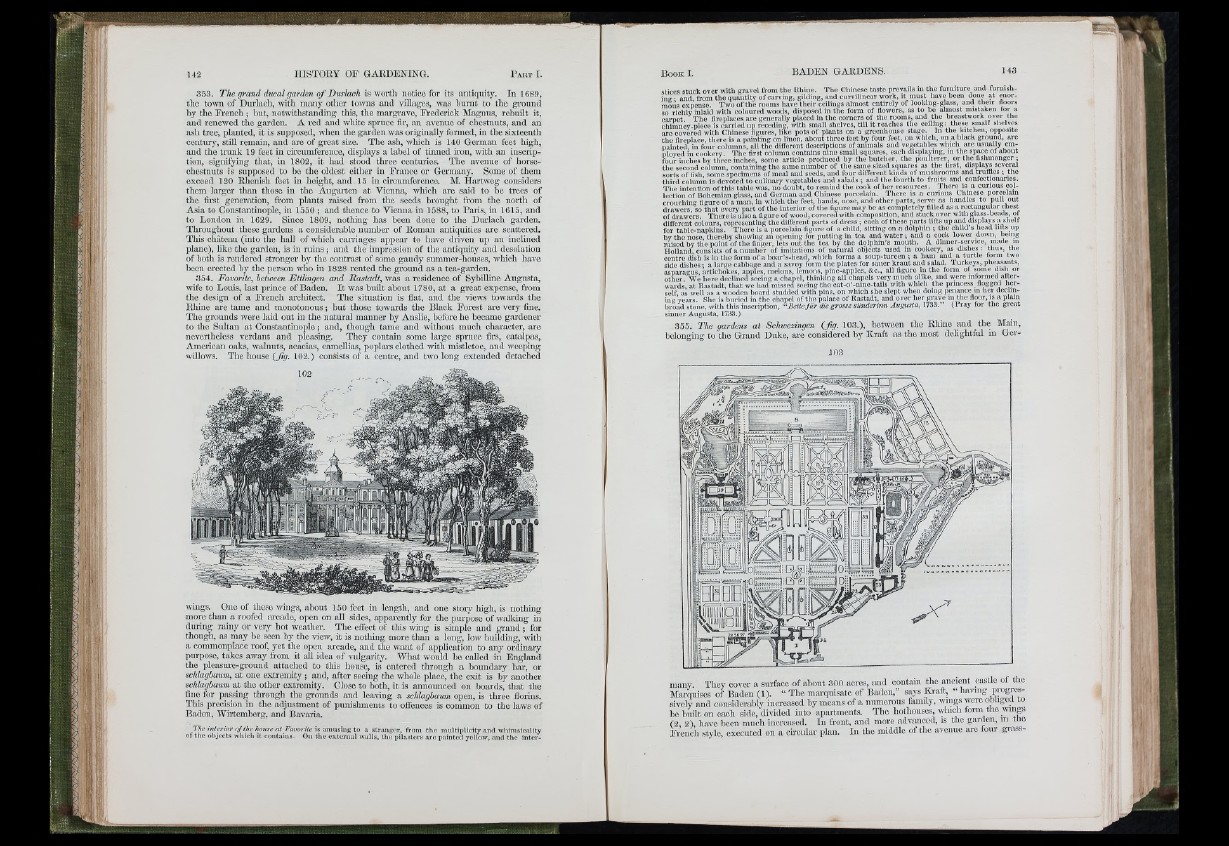
willows. The house ( fg . 102.) conèists of a centre, and tivo long extended detached
wings. One of ftcse wings, about 150 feet in length, and one story high, is nothing
more than a roofed ai-cade, open on all sides, apparently for the purpose of walking in
during rainy or very hot weather. The effect of tliis wing is simple and gi-and ; for
though, as may be seen by tlie view, it is nothing more than a long, low building, with
a commonplace roof, yet the open arcade, and tlic want of apphcation to any o i^ n a ry
purpose, takes away from it all idea of vulgarity. What would be called in England
the pleasure-gi-ound attached to this house, is entered through a boundary bai-, or
schlagbaum, at one extremity; and, after seeing the whole place, the exit is by another
schJagbaum at the other extremity. Close to both, it is announced on boards, that the
fine for passing through the groimds and leaving a schlagbaum open, is tlu-co florins.
This precision in the adjustment of puiiislimciits to oftences is common to the laws of
Baden, Wutcmbcrg, and Bavaria.
I'/ic interior of the house at Favorite is amusing to a stranger, from tho multiplicity and whimsica
ol the objects wlucli it contains. On th e external walls, the pila.sters arc painted yellow, and th e im
i whimsicality
‘....... ' ............................- - - ........................................’ ■' intcrstices
stuck over with gravel from the Rhino. The Chinese taste prevails in the furniture and furnish-
inc • and, from the quantity of carving, gilding, and curvilinear work, it must_ have been done a t enormous
expense. Two of the rooms have their ceilings almost entirely of looking-glass, and their f to r s
so richly inlaid with coloured woods, disposed in the form of llowers, as to be almost mistaken for a
carnet T h e fireplaces are generally placed in the corners of the rooms, and th e breastwork over the
chimney-piece is carried up receding, with small shelves, till it reaches the ceiling: these small shelves
arc covered with Chinese figures, like pots of plants on a greenhouse stage. In the kitchen, opposite
th e fireplace, there is a painting on linen, about three feet by four feet, on which, on a black ground, are
painted, in four columns, all the different descriptions of animals and vegetables which are usually em-
ploved in cookery. The first column contains nine small squares, each displaying, in the space of about
four inches by th ree inches, some article produced by the butcher, th e poulterer, or t f t fishmonger ;
th e second column, containing the same number of the same sized squares as the first, displaj^ several
sorts of fish some specimens of meal and seeds, and four different kinds of mushrooms and trumes ; the
third column is devoted to culinary vegetables and salads ; and the fourth to fruits and coniectionaries.
The intention of this table was, no doubt, to remind the cook of her resources. There is a curious collection
of Bohemian glass, and German and Chinese porcelain. There is a curious Chinese porcelain
crouchine figure of a man, in which the feet, hands, nose, and other parts, serve as handles to pull out
drawers, so th a t every part of the interior of the figure may be as completely filled as a rectangular chest
of drawers There is also a figure of wood, covered with composition, and stuck over with glass-beads, of
different colours, representing the different parts of dress ; each of these parts lifts up and displays ii shelf
for table-napkins. There is a porcelain figure of a child, sitting on a dolphin ; the child s head l i f t up
by the nose, thereby showing an opening for putting in tea and water ; and a cock lower down, f tin g
raised by the point of the finger, lets out the tea by th e dolphin’s mouth. A dinncr-service, made ni
Holland consists of a number of imitations of natura l objects used m cookery, as dishes: thus, the
centre dish is in th e form of a boar’s-head, which forms a soup-tureen ; a ham and a tu rtle form two
side dishes : a large cabbage and a sayoy form the plates for sauer k ra u t and salad. Turkeys, pheasants,
asparagus, artichokes, apples, melons, lemons, pine-apples, &c., all figure m th e form ot some dish or
other. We here declined seeing a chapel, thinking all chapels yery much alike, and were mfftmed a f t r -
wards at Rastadt, that wo had missed seeing the cat-o’-nine-tails with which th e princess flogged h erself
as well as a wooden board studded with pins, on which she slept when doing penance m her declin..
inec years. She is buried in tho chapel o fth e palace of Rastadt, and over her grave in the floor, is a plain
broad stone, with this inscription, "Bette fi lr die grosse sunderinn Augusta, 1733.” (Pray for th e great
sinner Augusta, 1733.)
355. The gardens at Schwezingen ( fg . 103.), between tbe Rbine and the Main,
belonging to the Grand Duke, arc considered by Kraft as the most delightful in Gcrniany.
They cover a surface of about 300 acres, and contain the ancient castle of the
Marcmiscs of Baden (1). “ The marqnisate of Baden,” says f ta f t, “ havmg pmgressively
and considerably increased hy means of a numerous family, Avings were obliged to
be built on each side, divided into apartments. The hotliouses, winch form the wings
(2, 2), have been much increased. In front, and more advanced, is the g a rftn , m tlic
French style, executed on a cfrciilai- plan. In the middle ol the avenue arc four grass