Liberty”, as it was called (v. the section on the History of Sweden), by the
energetic initiative of Jonas Alstromer. This prominent economist, like Gustavus
Vasa, introduced foreign improved breeds of cattle into the kingdom, and he
indicated the method by which the greater part of our existing stock of
cattle is nowadays improved, for he recommended cross-breeding, and pointed
out that the improvement of the breeds of cattle should be brought about “by
crossing good sires with poor females”.
The efforts made during the “Period of Liberty” for the development of cattle-
rearing were, it is true, crowned with success at first, but in the- middle of the
18th century the cattle plague reached Sweden, and destroyed the farmers1]
hopes of better times. After the Alstromer period, cattle-rearing steadily declined,
in spite of the fact that interest in efforts for the improvement of the industry
seems to have awakened to fresh life during the reign of Gustavus HI, when]
private initiative came to the fore, and, among other things, brought about the]
import of breeding-cattle from Holland, Denmark, and other countries.
The Agricultural Societies and the Academy of Agriculture (see pp. 142 and]
122) at first met with great difficulties and could do very little to assist]
the cattle-rearing industry. During the years of warfare at the beginning oil
the 19th century, the economic position of the entire country was a very, bad]
one, the country being brought to the brink of ruin-and bankruptcy, so that,
when peace was re-established, Sweden’s economic position was in much the
same position as it was at the death of Charles XII. Heavier animals of improved
breeds were not considered suitable in consideration of the then existing]
condition of the country, but the import of such animals continued, although
on a small scale.
During the decennium 1830—40, breeding cattle began to be imported in greater]
numbers, and thus commenced a new era in the history of Swedish cattle-rearing]
The first steps were taken by a private individual, Alexis Noring, who, after several]
years’ study of agriculture in England, succeeded in interesting many prominent
Swedish land-owners in the procuring of better breeding-stock from abroad, prim
Swedish, Lowland Cattle (>Prince Johm, Arlov).
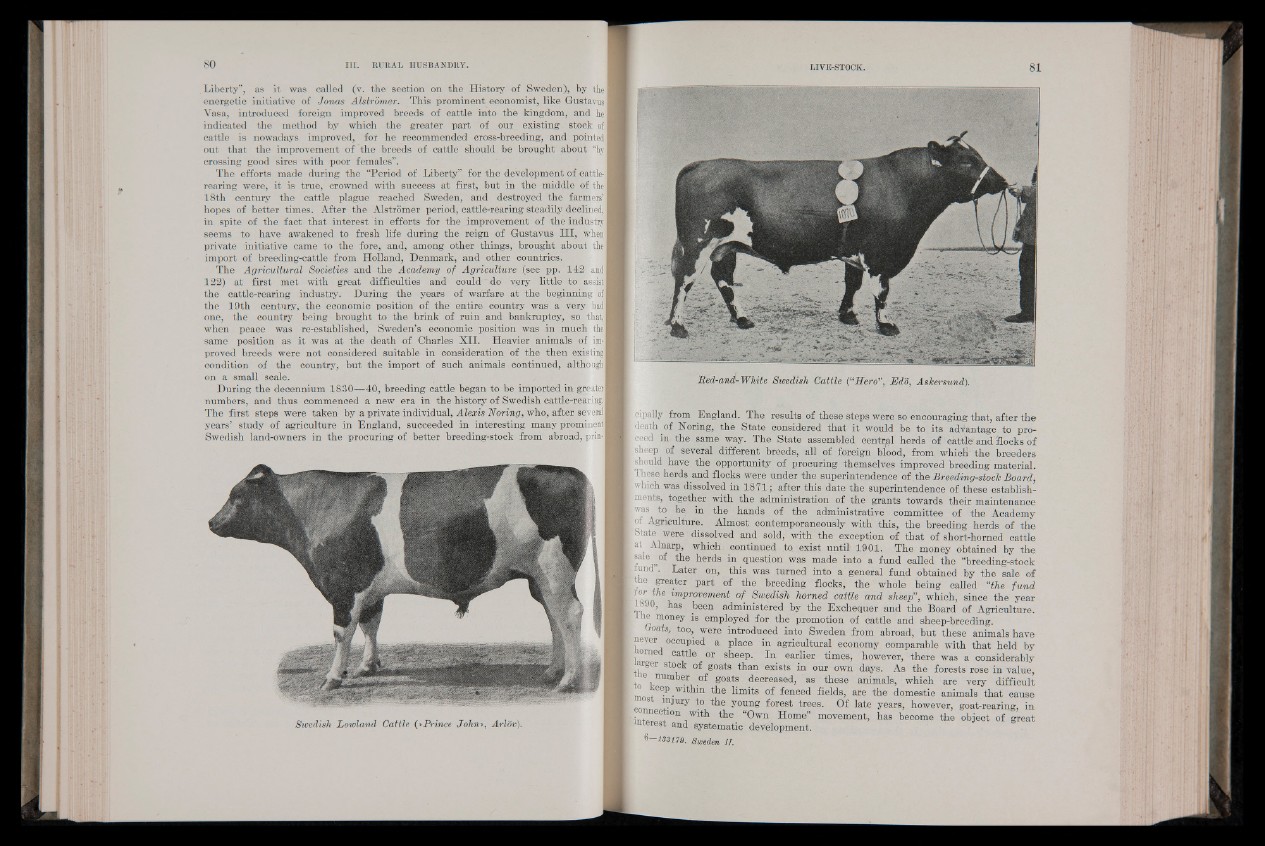
Bed-and-White Swedish Cattle {“Hero", Edö, Askersund).
cipally from England. The: results of these steps were so encouraging that, after the
death of Noring, the State considered that it would be to its advantage, to proceed
:|n. the same way. The State assembled central herds of cattle and ílocks of
sheep; of several different breeds, all of foreign blood, from whicË the breeders
should have the opportunity of procuring themselves improved breeding material.
These herds and flocks were under the superintendence of the, Breeding-stock Board,
which was dissolved in 1871 ; after this date the superintendence of these establishments,
together with the administration of the grants towards their maintenance
was to be in the hands of the administrative committee of the Academy
of Agriculture. Almost contemporaneously with this, the breeding herds of the
State were dissolved and sold, with the exception of that of short-homed cattle
at Alnarp, which, continued to exist until 1901. The money obtained by the
sa le .o f the herds in question was made into a fund called the “breeding-stock
| | 9 | Later 0I1> this was turned into a general fund obtained by the sale of
e greater part of the breeding flocks, the whole being called “the fund
■IRQn lmprovement ° f Swedish horned cattle and sheep", which, since the year
1890, has been administered by the Exchequer and the Board of Agriculture,
the money is employed for the promotion of cattle and sheep-breeding.
Coats, too, were introduced into Sweden from abroad, but these animals have
mever occupied a place in agricultural economy comparable with that held by
omed cattle or sheep. In earlier times, however, there was a considerably
arger stock of goats than exists in our own days. As the forests rose in value,
e number of goats decreased, as these animals, • which are very difficult
o keep within the limits of fenced fields, are the domestic animals that cause
mjury to the young forest trees. Of late years, however, goat-rearing, in
lnto-eV ° n t t e “0w n Home” movement, has become the object of great
rest and systematic development.
6 133179. Sweden 1J.