of prolific herring-fishing- on the Bohus coast began in 1877 and continued
up to the close of the century. In the middle of the first decade
of the new century, after a few years’ unsuccessful seine-fishing (vad-
fiske), the Bohuslan herring-fishery began to flourish again, deep-sea-
fishing being commenced with purse seines (snorpvadar), from boats
provided with motors. During the last few winters, herring-fishery has
been carried on by means of trawling and occasionally at great depths.
The existing herring-fishery on the West Coast cannot be compared with
any previous herring-fishery period in the old sense of the term. I t is
possible that, had the two methods of herring-fishing just mentioned been
known at an earlier date, successful fishery would have been possible even
during the intervals between the good fishing periods in past times. In
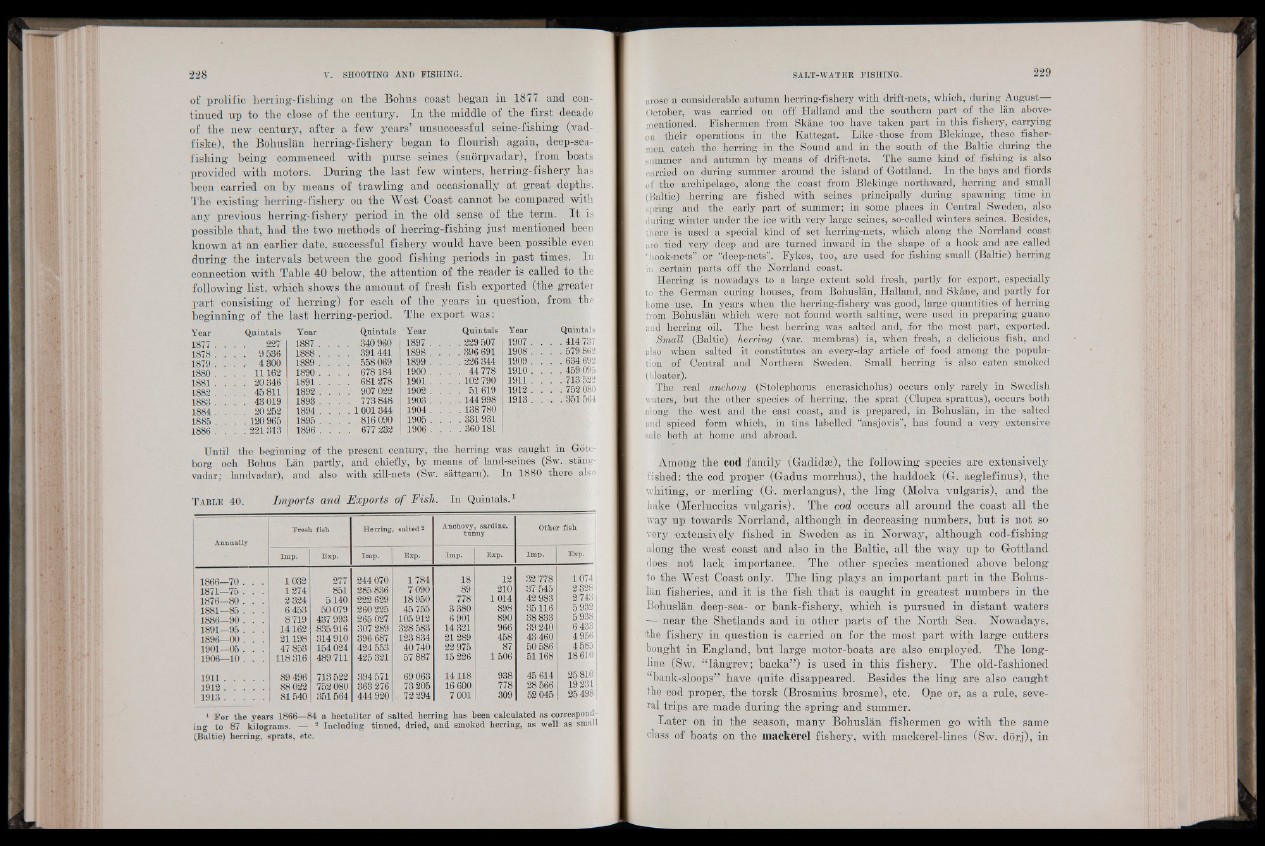
connection with Table 40 below, the attention of the reader is called to the
following list, which shows the amount of fresh fish exported (the greater
part consisting of herring) for each of the years in question, from the
beginning of the last herring-period. The export was:
Year
Quintals Year Quintals Year Quintals Year Quintals
1877 . .
227 1887 . . . . 340 960 1897 . . . . 229 507 1907 . . . . 414737
1878 . .
1888 . . . . 391 441 1898 1908 1 . . . 579 862
1879 . .
4 300 1889 . . . . 558 069 1899 . . . . 226 344 1909 . . . . 634 692
1880 . .
11162 1890 . . . . 678 184 1900 . . . . 44 778 1910. . . . 459 095
1881 . .
20346 1891 . . . . 681278 1901 . . . . 102 790 1911 . . . . 713 522
1882 . .
45 811 1892 . . . . 907 022 1902 . . . . 51619 1912 . . . . 752 080
1883 . .
43019 1893 . . 1 . 773 848 1903 . . . . 144 998 1913 . . . . 351564
1884 I .
20 252 1894 . . . . 1001 344 1904 . . . . 138 780
1885 . .
120 965 1895 816 090 1905
1886 . .
221313 1896 . . . . 677 232 1906 . . . . 360 181
Until the beginning of the present century, the herring was caught in Gote-
borg och Bohus Lan partly, and chiefly, by means of land-seines (Sw. stang-
vadar; landvadar), and also with gill-nets (Sw. sattgam). In 1880 there also
T a b l e 40. Imports and Exports of Fish. In Quintals.1
An n u a lly
Fre sh fish Herrin g , salted 2 Anchovy, sardine,
tn n n y
. O the r fish
Imp. Exp. Im p . Exp. Imp. Exp. Im p . Exp.
1866—7 0 . . . 1032 277 244 070 1784 18 . 12 32 778 . 1074
1871—75 . . . 1274 851 285 836 7 090 89 210 37 545 2 328
1876—80 . . . 2 324 5140 222 629 18 950 778 1014 42 983 2 743
1 1881—85 . . . 6 453 50 079 260 225 45755 3 380 898 35116 5 932
i 1886—90 . . . 8719 437 993 265 027 105 912 6 901 890 38833 5 938
1891—95 . . . 14162 835 916 307 289 328583 14 321 966 39 240 6 433
1896—00 . . . 21198 314910 396 687 123 834 21289 458 43460 4 956
1901—05 . . . 47 853 154024 424 553 40 740 22 975 87 50 586 4585
1906—10 . . . 118 316 489 711 425 321 . 57 887 15 226 1506 51168 18 610
1911................ 89 496 713 522 394 571 69 063 14118 938 45 614 25810
1912................ 88 022 752 080 363 276 73205 16 600 778 28 566 19 231
1913................ 81540 351564 444 920 72 294 7 001 309 52 045 25 498
1 For the years 1866—84 a hectoliter of salted herring has been calculated as corresponding
to 87 kilograms. — 2 Including tinned, dried, and smoked herring, as well as small
(Baltic) herring, sprats, etc.
arose a considerable autumn herring-fishery with drift-nets, which, during August—
October, was carried on off Halland and the southern part of the lan above-
mentioned. Fishermen from Skane too have taken part in this fishery, carrying
on their operations in the Kattegat. - Like -those from Blekinge, these fishermen.
catch the herring in the Sound and in the south of the Baltic during the
summer and autumn by means of drift-nets. The same kind of fishing is also
carried on during summer around the island of Gottland. In the bays and fiords
of the archipelago, along the coast from Blekinge northward, herring and small
(Baltic) herring are fished with seines principally during spawning time in
spring and the early part of summer; in some places in Central Sweden, also
during winter under the ice with very large seines, so-called winters seines. Besides,
there is used a special kind of set herring-nets, which along the Norrland coast
are tied very deep and are turned inward in the shape of a hook and are called
“hook-nets” or “deep-nets”. Fykes, too, are used for fishing small (Baltic) herring
in certain parts off the Norrland coast.
Herring is nowadays to a large extent sold fresh, partly for export, especially
to the German curing houses, from Bohuslan, Halland, and Skane, and partly for
home use. In years when the herring-fishery was good, large quantities of herring
from Bohuslan which were not found worth salting, were used in preparing guano
and herring oil. The best herring was salted and, for the most part, exported.
Small (Baltic) herring (var. membras) is, when fresh, a delicious fish, and
also when salted it constitutes - an every-day article of food among the population
of ■ Central and Northern Sweden. Small herring is also eaten smoked
(bloater).
The real anchorry (Stolephorus encrasicholus) occurs only rarely in Swedish
waters, but the other species of herring, the sprat (Clupea sprattus), occurs both
along the west and the east coast, and is prepared, in Bohuslan, in the salted
and spiced form which, in tins labelled “ansjovis”, has found a very extensive
sale both at home and abroad.
Among the cod family (Gadidse), the following species are extensively
fished: the cod proper (Gadus morrhna), the haddock (G. aeglefinus), the
whiting, or merling (G. merlangus), the ling (Molva vulgaris), and the
hake (Merluccius vulgaris). The cod occurs all around the coast all the
way up towards Norrland, although in decreasing numbers, but is not so
very extensively fished in Sweden as in Norway, although cod-fishing
along the west coast and also in the Baltic, all the way up to Gottland
does not lack importance. The other species mentioned above belong
to the West Coast only. The ling plays an important part in the Bohuslan
fisheries, and it is the fish that is caught in greatest numbers in the
Bohuslan deep-sea- or bank-fishery, which is pursued in distant waters
— near the Shetlands and in other parts of the North Sea. Nowadays,
the fishery in question is carried on for the most part with large cutters
bought in England, but large motor-boats are also employed. The long-
line (Sw. “langrev; baeka”) is used in this fishery. The old-fashioned
‘bank-sloops” have quite disappeared. Besides the ling are also caught
the cod proper, the torsk (Brosmius brosme), etc. One or, as a rule, several
trips are made during the spring and summer.
Later on in the season, many Bohuslan fishermen go with the same
class of boats on the mackerel fishery, with mackerel-lines (Sw. dorj), in