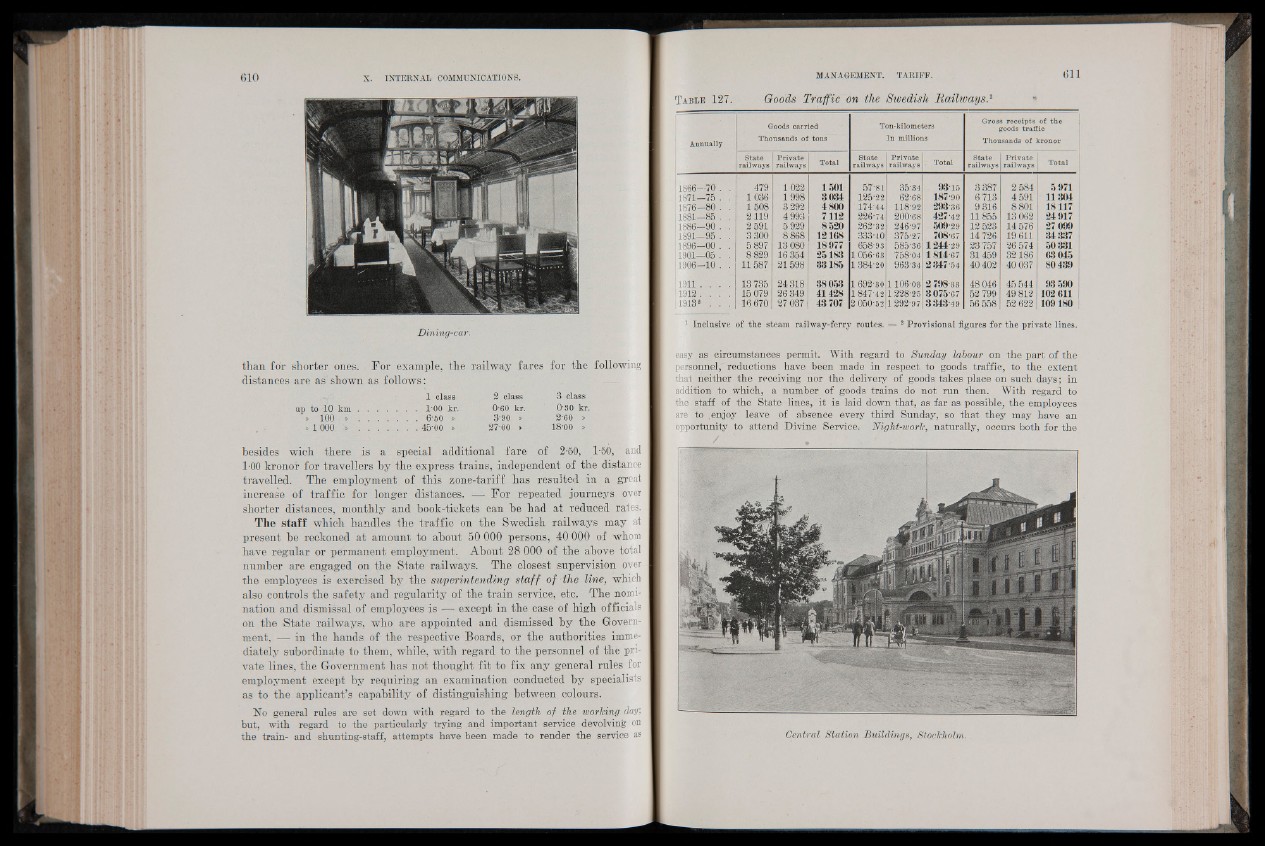
Dining-car.
than for shorter ones. For example, the railway fares for the following
distances are as shown as follows:
1 class 2 class 3 class
up to 10 k m ........................... l'OO kr. 0'60 kr. 0‘3O kr.
> 100 » 6*50 > 3'90 » 2*60 * *
. » 1000 ;» . . . . . . . . 45*00 » 27*00 » . 18*00 1
besides wich there is a special additional fare of 2*50, 1*50, -and
1*00 kronor for travellers by the express trains, independent of the distance
travelled. The employment of this zone-tariff has resulted in a great
increase of traffic for longer distances. — For repeated journeys over
shorter distances, monthly and book-tiekets can he had at reduced rates.
The staff which handles the traffic on the Swedish railways may at
present he reckoned at amount to ahout 50 000 persons, 40 000 of whom
have regular or permanent employment. Ahout 28 000 of the ahove total
number are engaged on the State railways. The closest supervision over
the employees is exercised hy the superintending staff of the line, which
also controls the safety and regularity of the train service, etc. 'The nomination
and dismissal of employees is — except in the case of high officials
on the State railways, who are appointed and dismissed hy the Government,
— in the hands of the respective Boards, or the authorities immediately
subordinate to them, while, with regard to the personnel of the private
lines, the Government has not thought fit to fix any general rules for
employment except hy requiring an examination conducted hy specialists
as to the applicant’s capability of distinguishing between colours.
No general rules are set down with regard to the length of the working day,
but, with regard to the particularly trying and important service devolving on
the train- and shunting-staff, attempts have been made to render the service as
Table 127. Goods Traffic on the Swedish Railways.1
Annually
Goods c a rried
T hou san d s o f to n s
Ton-kilometers
In millions
Gross re c e ip ts of th e
goods tra ffic
Thousands of k ro n o r
S ta te
railway s
P riv a te
railways T o tal
S ta te
railway s
P r iv a te
railw ay s , T o ta l S ta te
railways
P r iv a te
railw ay s T o ta l
1866-^70 . . 479 1 022 1501 57*81 35*34 93*15 3 387 2 584 5971
1871—75 . . 1036 1998 3034 125*22 62*68 187*90 6 713 4591 11304
1876—80 . . 1 508 3 292 4800 174*44 118*92 293*36 9 316 8 801 18117
1881-85 . . 2119 4 993 7112 226*74 200*68 427*42 11855 13 062 24 917
1886—90 . . 2 591 5 929 8 520 262*82 246*97 509*29 12 523 14 576 27 099
1891—95 . . 3 300 8868 12168 333*40 375*27 708*67 14 726 19 611 34337
1896—00 . . 5 897 13 080 18977 658*98 585*36 1244 29 23 757 26 574 50331
1901—05 . . 8 829 16 354 25183 1056*63 758*04 1814*67 31459 32186 63045
1906—10 . . 11587 21 598 33185 1 384*20 963*34 2347*54 40 402 40 037 80439
1911 . . . . 13 735 24 318 38 053 1 692*30 1106*03 2 798*33 48 046 45 544 93 590
1912. . . 1 15 079 26 349 41428 1847*42 1 228*25 3 075*67 52 799 49812 102611
119132 . . . 16 670 27 037 43 707 2 050*52 1 292*97 3 343*49 56 558 52 622 109180
1 Inclusive of the steam railway-ferry routes, 2 Provisional figures for the private lines.
easy as circumstances permit. With regard to Sunday labour on the part of the
personnel,' reductions have been made in respect to goods traffic, to the extent
that neither the receiving nor the delivery of goods takes place on such days; in
addition to which, a number of goods trains do not run then. With regard to
the staff of the State_ lines, it is laid down that, as far as possible, the employees
arelto .enjoy leave of absence every third Sunday, so that they may have an
opportunity to attend Divine Service. Night-work, naturally, occurs both for the