train-, station-, and inspection staffs, on lines where night-trains run. This, however,
is chiefly the case as far as concerns the State railways.
The rates of wages vary, of course, on different lines and for different kinds
of service. In the main, they may be said to equal, or to be higher than, those
paid on railways in neighbouring countries. The recent marked increase in the
cost of living has, however, led to changes in the wages of the staff. With
regard to State railways, such alterations came into operation at the beginning
of 1907; and changes in the rates of wages have gradually been introduced on
the private railways during the last few years. A signalman or porter on ~ the.
State railways at present enjoys (including 336 kronor, the estimated value of
rooms and fuel in Stockholm, 120 kronor for .clothing, and 60 kronor for special
expenses in certain localities) not less than 1 356, and not more than 1 656
kronor per annum. A line-man gets, including the same privileges, at least
1 158 kronor and not more than 1 458 kronor per annum. Prom these wages,
however, are deducted the obligatory payments towards pensions. The system
of self-help, in the form of Savings- and benefit funds, Life Insurance Unions,
and such like institutions has become extremely popular amongst railway employees
throughout the entire kingdom; and in connection .with these, mention
should be made of the Pension institutions established, which with the object
partly of affording relief for the members, themselves in old age, partly as a
means of support for those they may leave behind them — are supported by
the Public Treasury, in the case of the State railways; and in the case of the
private railways, by the lines interested. The pensions of the employees of the
State railways are, nowadays, paid direct by the Treasury.
Station in the Provinces (Questa).
No railway purely strategical lines, have hitherto been built in Sweden,
but the project for. every proposed new line must he scrutinized beforehand
by the General Staff, which has to see that military claims áre duly considered.
The control of the work for the use of railways for military purposes
belongs, in the first place, to the chief of the General Staff acting
through a special department for communications, in which department care-
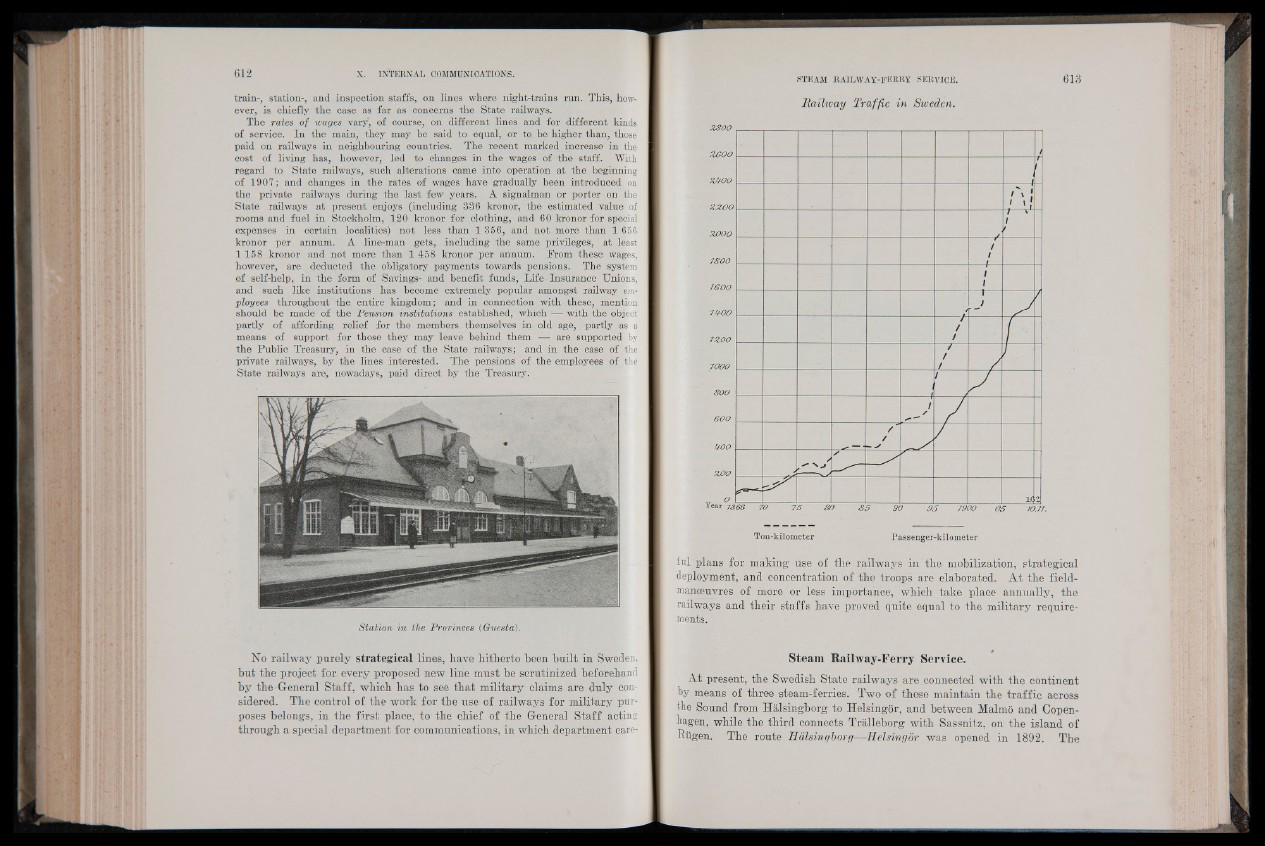
Railway Traffic in Sweden.
Ton-kilometer Passenger-kilometer
iul plans for making use of the railways in the mobilization, strategical
deployment, and concentration of the troops are elaborated. At the field-
manceuvres of more or less importance, which take place annually, the
railways and their staffs have proved quite equal to the military requirements.
Steam Railway-Ferry Service.
At present, the Swedish State railways are connected with the continent
by means of three steam-ferries. Two o f these maintain the traffic across
the Sound from Halsingborg to Helsingor, and between Malmo and Copenhagen,
while the third connects Tralleborg with Sassnitz, on the island of
Riigen. The route Halsingborg—Helsingor was opened in 1892. The