that several of the modern electro-chemical branches of industry are not
very dependent on their locality and can often utilize even that part of the
water-power which is only available during certain parts of the year.
The Distribution of Waterfalls. How the waterfalls are distributed
over Sweden will be seen from the following figures, taken from the work
cited above, “ Sveriges nati onalfòrmogenhet” :
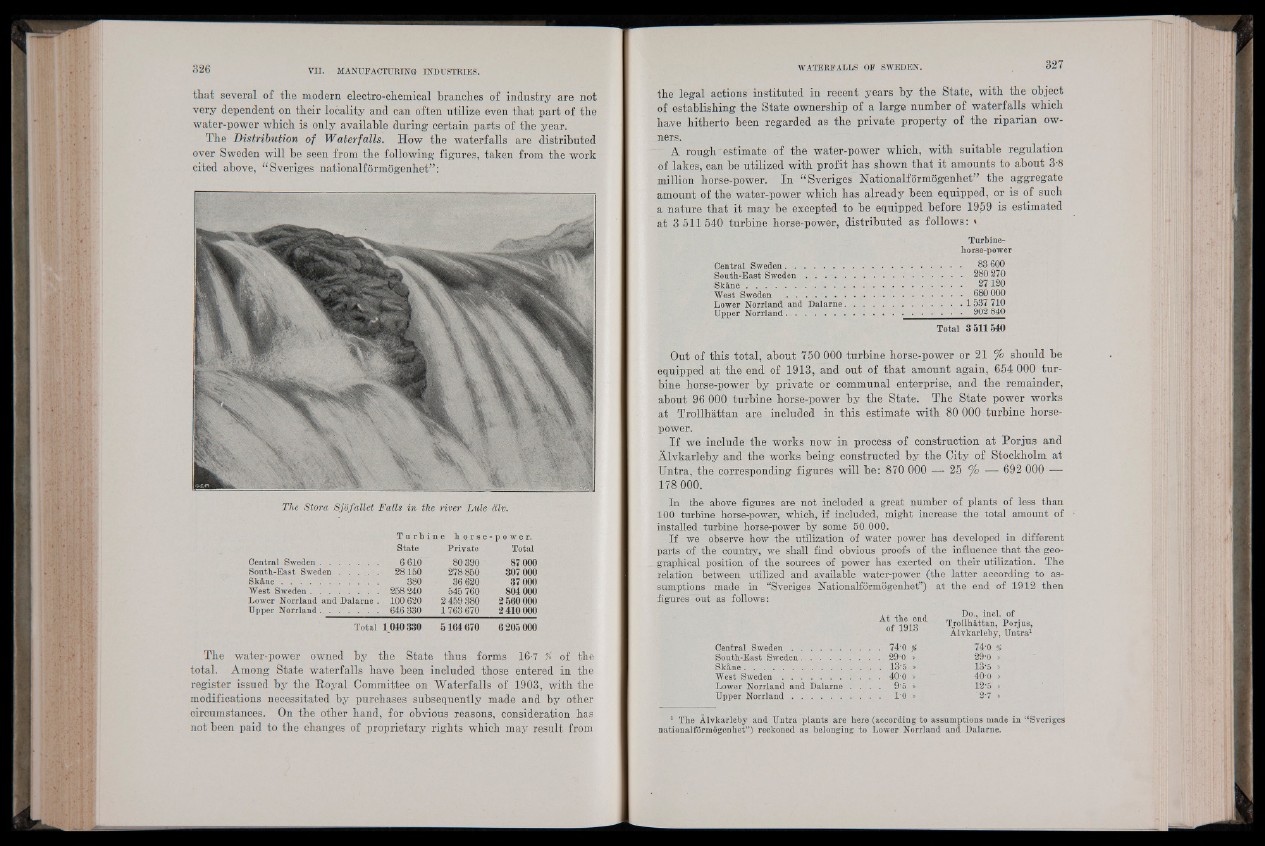
The Stora Sjofallet Falls in the river Lule alv.
T n rh in e h o r s e -■power.
State Private Total
Central Sweden . . ................ 6 610“ 80 390 87 000
South-East Sweden ................ 28150 278 850 307 000
Skâne .................... — — 380 36 620 37 000
West Sweden . . . ................ 258 240 545 760 804000
Lower Norrland and Dalarne . 100 620 2 459 380 2560 000
Upper Norrland. . . . . . . 646 330 1763 670 2410000
Total 1040 330 5164670 6 205 000
The water-power owned by the State thus forms 16-7 % of the
total. Among State waterfalls have been included those entered in the
register issued by the Royal Committee on Waterfalls of 1903, with the
modifications necessitated by purchases subsequently made and by other
circumstances. On the other hand, for obvious reasons, consideration has
not been paid to the changes of proprietary rights which may result from
the legal actions instituted in recent years by the State, with the object
of establishing the State ownership of a large number of waterfalls which
have hitherto been regarded as the private property of the riparian owners.
A rough'estimate of the water-power which, with suitable regulation
of lakes, can be utilized with profit has shown that it amounts to about 3-8
million horse-power. In “ Sveriges Nationalformogenhet” the aggregate
amount of the water-power which has already been equipped, or is of such
a nature that it may be excepted to be equipped before 1959 is estimated
at 3 511 540 turbine horse-power, distributed as follows: »
Turbinehorse
power
Central Sweden 83 600
South-East Sw e d e n .................................................................... 280 270
Sk&ne . ............................................ 27120
"West Sweden .......................................................................... 680000
Lower Norrland and D a la rn e ............................................ 1537 710
Upper Norrland............................................... 902 840
Total 8511540
Out of this total, about 750 000 turbine horse-power or 21 °fo should be
equipped at the end of 1913, and out of that amount again, 654 000 turbine
horse-power by private or communal enterprise, and the remainder,
about 96 000 turbine horse-power by the State. The State power works
at Trollbattan are included in this estimate with 80 000 turbine horsepower.
I f we include the works now in process of construction at Porjus and
Alvkarleby and the works being constructed by the City of Stockholm at
Untra, the corresponding figures will be: 870 000 — 25 °/o — 692 000 —
178 000.
In the above figures are no t included a great number of plants of less th an
100 turbine horse-power, which, if included, might increase th e to ta l amount of
installed turbine horse-power by some 50 000.
I f we observe how th e utilization of water power has developed in different
parts of th e country, we shall find obvious proofs of th e influence th a t th e geographical
position of th e sources of power has exerted on th e ir utilization. The
relation between utilized and available water-power (th e la tte r according to assumptions
made in “Sveriges Nationalformogenhet”) a t th e end of 1912 th en
figures out -as follows:
At the end
of 1913
Do., incl.
Trollhattan,
Alvkarleby,
Central Sw ed e n ................................... . . 74-0 % 74-0 %
South-East Sweden........................ . . 2 9 '0 » 29-0 »
Sk&ne................................................. . . 13-5 > 1 3'5 »
W est Sw ed e n ................................ . . 40-0 » 40-0 »
Lower Norrland and Dalarne . . . . 9 '5 > 1 2'5 »
Upper N o rrlan d ............................ . . 1-0 > 1 Ü >
1 The Alvkarleby and Untra plants are here (according to assnmptions made in “Sveriges
nationalformogenhet”) reckoned as belonging to Lower Norrland and Dalarne.