The Manufacture of Pig Iron.
Pig-iron was first manufactured in Sweden not later than the fifteenth
century: the date cannot be determined more precisely. The manufacture
of pig-iron gradually developed out of the process called blaster-
smide or the blast forging, the product of which was wrought iron.
Statistics of pig-iron manufacture are also unsatisfactory - for the earlier
periods: they can scarcely be said to be reliable before they get down to the
nineteenth century.
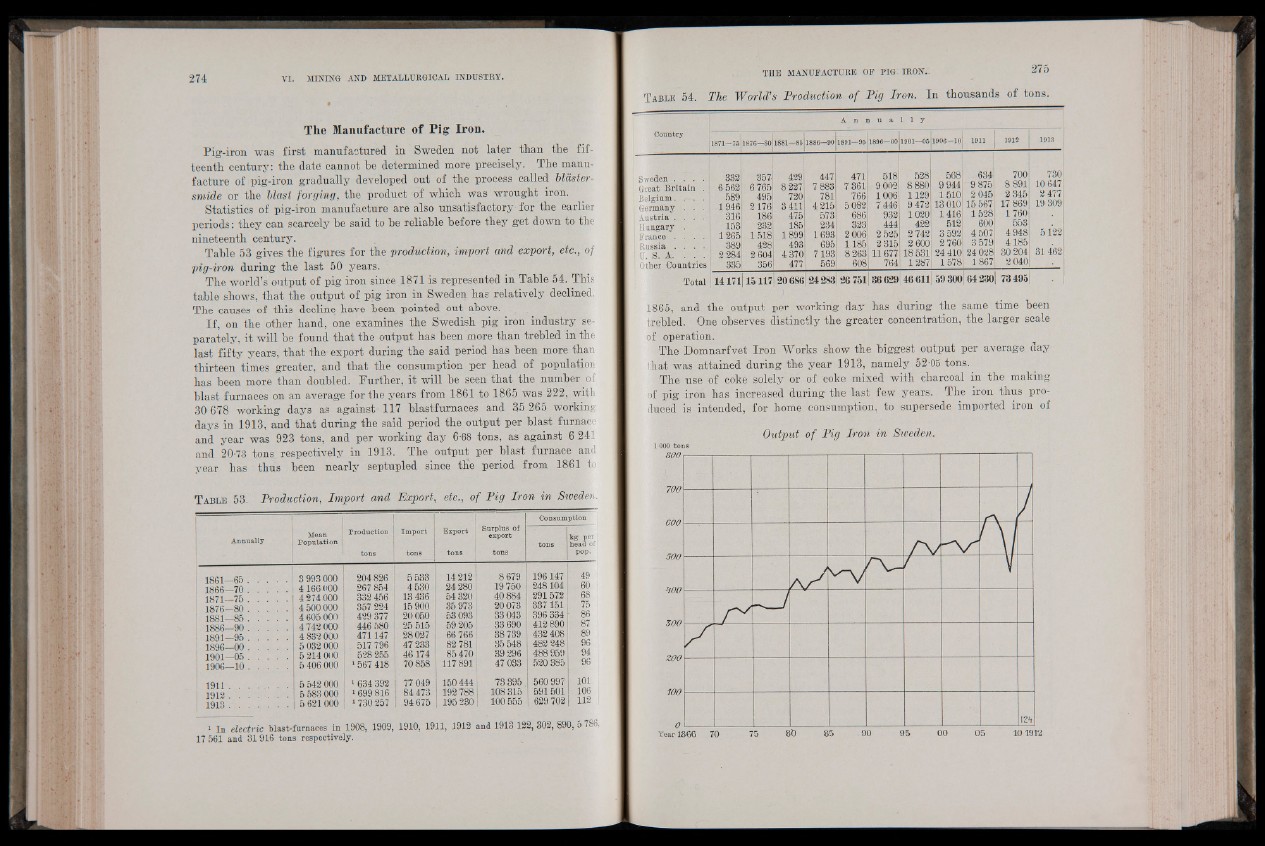
Table 53 gives the figures for the production, import and export, etc., of
pig-iron during the last 50 years.
The world’s output of pig iron since 1871 is represented in Table 54. This
table shows, that the output of pig iron in Sweden has relatively declined.
The causes of this decline have been pointed out above.
If, on the other hand, one examines the Swedish pig iron industry separately,
it will be found that the output has been more than trebled in the
last fifty years, that the-export during the said period has been more than
thirteen times greater, and that the consumption per head of population
has been more than doubled. Further, it will be seen that the number of
blast furnaces on an average for the years from 1861 to 1865 was 222, with
30 678 working days as against 117 blast-furnaces and 35 265 working
days in 1913, and that during the said period the output per blast furnace
and year was 923 tons, and per working day 6-68 tons, as against 6 241
and 20-73 tons respectively in 1913. The output per blast furnace and
year has thus been nearly septupled since tlfe period from 1861 ito
T able 53. Production, Import and Export, etc., of Pig Iron in Sweden.
Consumption
Annually
Mean
Population
Production Import Export Snrplus of
export
tons
kg per
head of
tons tons tons tons pop.
1861—65 ................
1866—70 ................
1871—75 ................
1876-80 ................
1881—85 ................
1886 90 ................
1891—95 ................
1896—00 ................
1901 05 ................
1906—10 ................
3 993 000
4166 000
4 274 000
4 500 000
4 605 000
4 742 000
4 832 000
5 032 000
5 214 01)0
5 406 000
204 826
267 854
332 456
357 224
429 377
446 580
471147
517 796
528 255
§ 567 418
5 533
4 530
13 436
15 900
20 050
25 515
28 027
47 233
46174
70 858
14212
24 280
54320
35 973
53 093
59 205
66 766
82 781
85 470
117 891
8 679
19750
40 884
20 073
33 043
33 690
38739
35 548
39 296
47 033
196147
248 104
291572
337151
396 334
412 890
432 408
482 248
488 959
520 385
Kv49
; 60
68
75
1 86
■ I
89
■ 96
94
96
191 1 ....................
191 2 ....................
191 3 ....................
5 542 000
5583 000
5 621 000
1 634 392
1 699 816
1730 257
77 049
84 473
94 675
150 444
192 788
195 230
73 395
108 315
100 555
560 997
591501
629 702
101
106
112
‘ In electric blast-furnaces in 1908, 1909, 1910, 1911, 1912 a n d 1 9 1 3 1 2 2 , 302, 890, 5 786,
17 561 and 31916 tons respectively.
THE MANUFACTURE OF PIG. IRON- 275
T a b le 54. The World’s Production of Pig Iron. In thousands of tons.
Country
A n u a i i y
1871—75 1876—80 1881—86 1886—90 1891—95 1896—00 1901—06 1906-10 1911 1 1912 1913
332 357- 429 447 471 518 528 568 634 700 730
6 562 6 765 8227 7 883 7 361 9 002 8 880 9 944 9 875 8 891 10 647
589 495 720 781 766 1006 1129 1510 2 045 2 345 2 477
J. 946 2176 3 411 4 215 5 082 7446 9 47-2 13 010 15567 17 869 19 309
316 1.86 475 573 686 932 1020 1416 1528 1 760
153 232 185 234 323 444 422 512 600 553
1265 1518 1899 1'693 2 006 2 525 2 742 3 592 4 507 4 948 5122
389 428 493 695 1185 2 315 2 600 2 760 3 579 4185
Ü. -S. A. . . . 2 284 2 604 4370 7193 8263 11677 18 531 24410 24 028 30 204 31 462
Other Countries 335 356 4771 569 608 764| 1287 1578 1867 2 040
Total 14 171 15117 20 686 24 283 26 751 36 629 46 611 59 300 64 230| 73495
1865, and the output per working day has during the same time been
trebled. One observes distinctly the greater concentration, the larger scale
of operation.
The Domnarfvet Iron Works show the biggest output per average day
that was attained during the year 1913, namely 52-05 tons.
The use of coke solely or of coke mixed with charcoal in the making
of pig iron has increased during the last few years. The iron thus produced
is intended, for home consumption, to supersede imported iron of
Output of Pig Iron in Sweden.
1 000 tons