stones being set up around it. Out of this primitive type of furnace
were then developed Osmund “ skallinga-r” and hearths of different
kinds and sizes. Osmund, that is, malleable iron produced direct, and
also steel were the sole products of the Swedish metal industry for centuries.
Copper seems scarcely to have been manufactured in Sweden before
the Middle Ages, but at all events not later than the 13th century.
Silver and Lead began to be extracted in the course of the 15th century,
perhaps earlier. Gold was found in Sweden in 1636, and there have
been preserved samples of Swedish gold from the year 1695. Zinc was
experimentally extracted for the first time in 1741, when also brass was
made out of exclusively Swedish metals, Cobalt began to be. exploited
in Sweden in 1745. Nickel was reduced on a manufacturing basis for. the
first time in 1839, on a larger scale in 1844. Manganese ore was utilised
as long- ago as the 17th century, but it was not till 1868 that a metallurgical
extraction of the metal by the production of spiegel iron commenced.
Chromium, and Tungsten, finally, are also Swedish metals; they have been
extracted in Sweden from ores since 1892 andii910 respectively. Mercury
was temporarely manufactured as a by-product at Sala in 1907. It is
not known, even approximately, when the mining of ore first began:
probably at the beginning of the Middle Ages, perhaps earlier. Coal
mining in Skane is mentioned for the first time in 1571. Trapes of mining’
of far older date have been discovered in the chalk deposits in Skane,
where flint was mined S 3 perhaps as early as the Stone Age M by the
sinking of shafts and stoping. Written records relating to Swedish
mining are not found till late, and the early history of mining in Sweden
is scanty in data. The earliest information on this subject is apparently
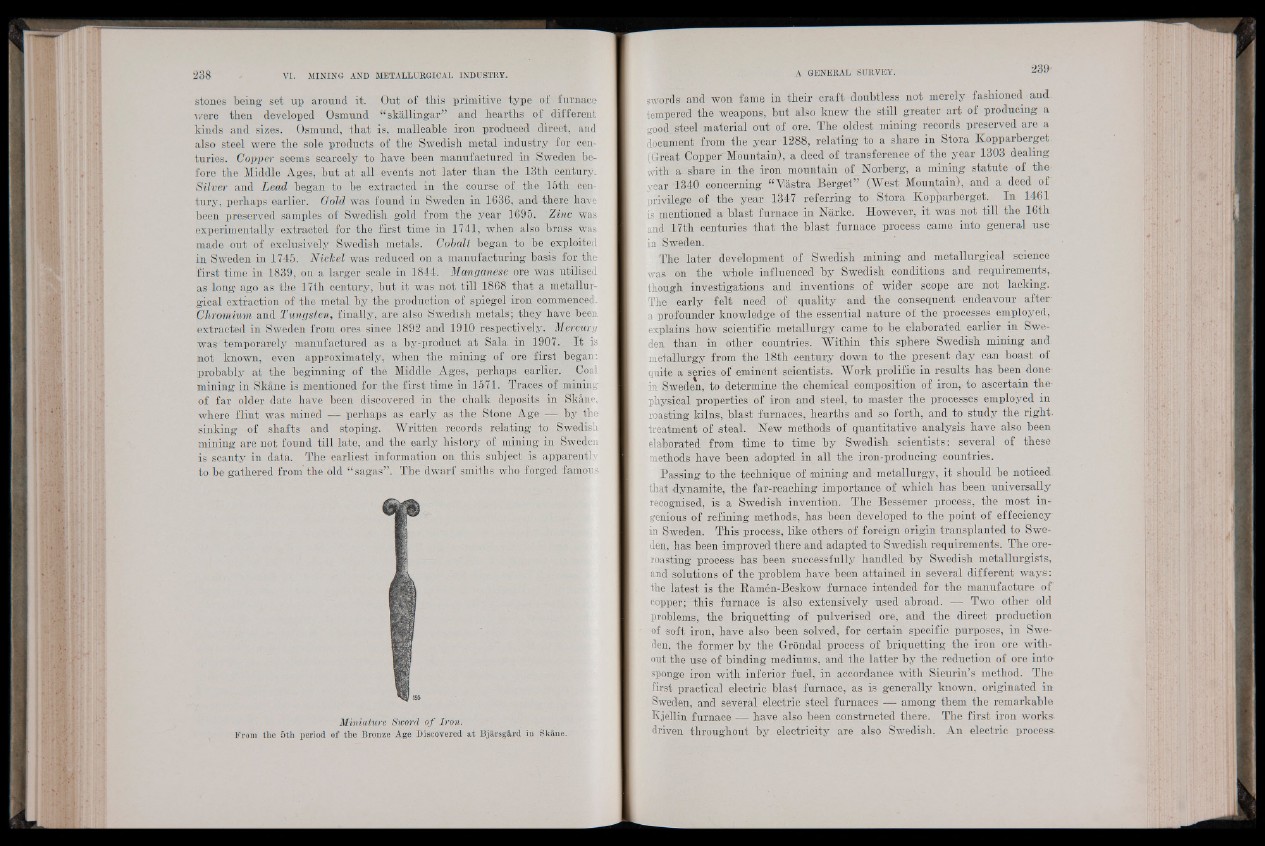
to be gathered from’the old “ sagas”. The dwarf smiths who forged famous
Miniature Sword o f Iron.
From the 5th period of the Bronze Age Discovered at Bjarsg&rd in Sk&ne.
swords and won fame in their craft doubtless not merely fashioned and.
tempered the weapons, but also knew the still greater art of producing a
good steel material out of ore. The oldest mining records preserved are a
document from the year 1288, relating to a share in Stora Kopparberget.
(Great Copper'Mountain), a deed of transference of the year 1303 dealing
with a share in the iron mountain of Norberg, a mining statute of the-
year 1340 concerning “Ylastra Berget” (West Mountain),-and a deed of
privilege of the year 1347 referring to Stora Kopparberget. In 1461
is mentioned a blast furnace in Nark-e. However, it was not till the 16th.
and 17th centuries that the blast furnace process came into general use
in Sweden.
The later development of Swedish mining and metallurgical science
was on the whole influenced by Swedish conditions and requirements,,
though investigations and inventions of wider scope are not lacking.
The/ early felt need of quality and the consequent endeavour after
a profounder knowledge of the essential nature of the processes employed,
explains how scientific metallurgy came to be elaborated earlier in Sweden
than in other countries^ Within this sphere Swedish mining and
metallurgy from the 18th century down to the present day can boast of
quite a series of eminent scientists. Work prolific in results has been done-
in -Sweden, to determine the chemical composition of iron,- to ascertain the-
physical properties of iron and steel, to master the processes employed in
roasting kilns, blast furnaces, hearths and so forth, and to study the right,
treatment of steal. New methods of quantitative analysis have also been
elaborated from time to time by Swedish scientists: several of these
methods have been adopted in all the iron-producing countries.
Passing to the technique of mining and metallurgy, it should be noticed
that dynamite, the far-reaching importance of which has been universally
recognised, is a Swedish invention.. The Bessemer process, the most ingenious
of refining methods, has been developed to the point of effeciency
in Sweden. This process, like others of foreign origin transplanted to Sweden,
has been improved there and adapted to Swedish requirements. The ore-
roasting process has been successfully handled by Swedish metallurgists,
and solutions of the problem have been attained in several different ways:
the latest is the Ramen-Beskow furnace intended for the manufacture o f
copper; This furnace is also extensively used abroad. - / - ( Two other old
problems, the briquetting of pulverised ore, and the direct production
of -soft iron, have also been solved, for certain specific purposes, in Sweden,
the former by the Grondal process of briquetting the iron ore without
the use of binding mediums, and the latter by the reduction of ore into
sponge iron with inferior fuel, in accordance with Sieurin’s method. Tho
first practical electric blast furnace, as is generally known, originated in
Sweden, and several electric steel furnaces — among them the remarkable
Kjellin furnace — have also been constructed there. The first iron works
driven throughout by electricity are also Swedish. An electric process