At the present time Sweden produces, except iron, no other metals but
copper, gold, silver, lead, and zinc.
Copper. The amount of copper ore at present mined in Sweden is very small,
as is manifest from Table 65, and the ore, which is obtained almost exclusively
from the Falun Mine, is not worked into metallic copper, but into copper vitriol.
On the other hand, metallic copper has since 1886 been manufactured from
im p o r ted copper ore (cupriferous pyrites with about 3 % of copper), mainly
from Norway.
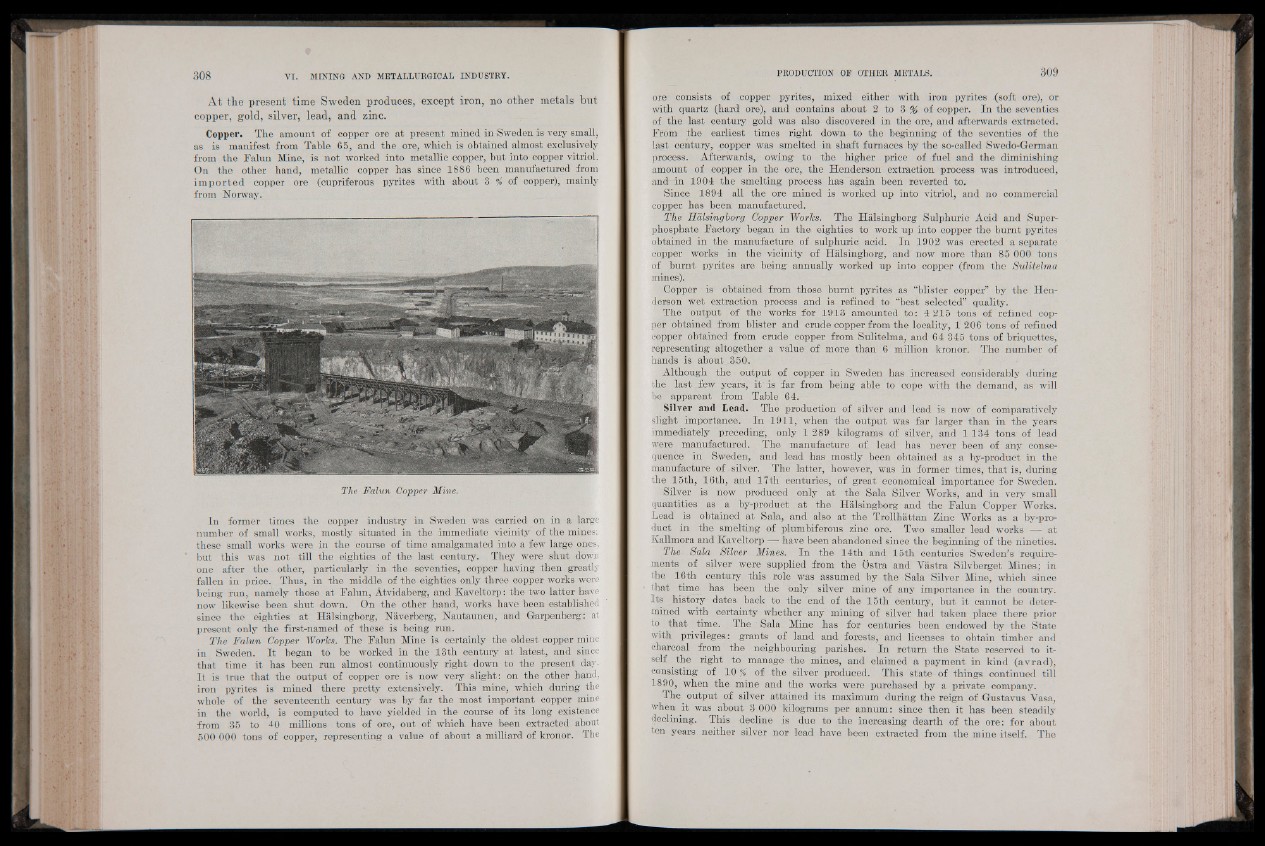
The Falun Copper Mine.
In former times the copper industry in Sweden was carried on in a large
number of small works, mostly situated in the immediate vicinity of the mines;
these small works were in the course of time amalgamated into a few large
but this was not till the eighties of the last century. They were shut down
one after the other, particularly in the seventies, copper having then greatly
fallen in price. Thus, in the middle of the eighties only three copper works were
being run, namely those at Falun, Atvidaberg, and Kaveltorp: the two latter have
now likewise been shut down. On the other hand, works have been established
since the eighties at Halsingborg, Naverberg, Nautaunen, and Garpenberg: at
present only the first-named of these is being run.
The Falun Copper Works. The Falun Mine is certainly the oldest copper mini!
in Sweden. It began to be worked in the 13th century at latest, and since
that time it has been run almost continuously right down to the present day.
It is true that the output of copper ore is now very slight: on the other hand,
iron pyrites is mined there pretty extensively. This mine, which during the
whole of the seventeenth century was by far the most important copper mine
in the world, is computed to have yielded in the course of its long existence
from 35 to AO millions tons of ore, out of which have been extracted about
500 000 tons of copper, representing a value of about a milliard of kronor. The
ore consists of copper pyrites, mixed either with iron pyrites (soft ore), or
with quartz (hard ore), and contains about 2 to 3 % of copper. In the seventies
of the last century gold was also discovered in the ore, and afterwards extracted.
From the earliest times right down to the beginning of the seventies of the
last century, copper was smelted in shaft furnaces by the so-called Swedo-German
process. Afterwards, owing to the higher price of fuel and the diminishing
amount! of copper in the ore, the Henderson extraction process was introduced,
and in 1904 the smelting process has again been reverted to.
Since 1894 all the ore mined is worked up into vitriol, and no commercial
copper has been manufactured.
The Halsingborg Copper Works. The Halsingborg Sulphuric Acid and Superphosphate
Factory began in the eighties to work up into copper the burnt pyrites
obtained in the manufacture of sulphuric acid. In 1902 was erected a separate
copper works in the vicinity of Halsingborg, and now more than 85 000 tons
of burnt pyrites are being annually worked up into copper (from the Sulitelma
mines).
Copper is obtained from those burnt pyrites as “blister copper” by the Henderson
wet extraction process and is refined to “best selected” quality.
The output of the works for 1913 amounted to: 4 215 tons of refined copper
obtained from blister and crude copper from the locality, l 1 206 tons of refined
copper obtained from crude copper from Sulitelma, and 64 345 tons of briquettes,
representing altogether a value of more than 6 million kronor. The number of
hands is about,350.
Although the output of copper in Sweden has increased considerably during
the la s t . few years, it is far from being able to cope with the demand, as will
be apparent from Table 64.
Silver and Lead. The production of silver and lead is now of comparatively
slight importance. In 1911, when the output was far larger than in the years
immediately preceding, only 1 289 kilograms of silver, and 1 134 tons of lead
were manufactured. The manufacture of lead has never been of any consequence
in Sweden, and lead has mostly been obtained as a by-product in the
manufacture o f , silver. The latter, however, was in former times, that is, during
thé 15th, 16th, and 17th centuries, of great economical importance for Sweden.
Silver is' now produced only at the Sala Silver Works, and in very small
quantities as a .by-product at the Halsingborg and the Falun Copper Works.
Lead is obtained at Sala, and also at the Trollbattan Zinc Works as a by-product
in the smelting of plumbiferous zinc ore. Two smaller lead works —' at
Kallmora and Kaveltorp — have been abandoned since the beginning of the nineties.
The. Sala Silver Mines. In the 14th and 15th centuries Sweden's requirements
of silver were supplied from the Ostra and Vastra Silvberget Mines; in
the 16th century this role was assumed by the Sala Silver Mine, which since
that time has béen the only silver mine of any importance in the country.
Its history dates back to the end of the 15th century, but it cannot be determined
with certainty whether any mining of silver had taken place there prior
to that time. The ' Sala Mine has for centuries been endowed by the State
with privileges: grants of land and forests, and licenses to obtain timber and
charcoal from the neighbouring parishes. In return the State reserved to itself
the right to manage the mines, and claimed a payment in kind (avrad),
consisting of 10 % of the silver produced. This state of things continued till
1890, when the mine and the works were purchased by a private company.
The output of silver attained its maximum during the reign of Gustavus Vasa,
when it was about 3 000 kilograms per annum : since then it has been steadily
declining. This decline is due to the increasing dearth of the ore: for about
ten years neither silver nor lead have been extracted from the mine itself. The