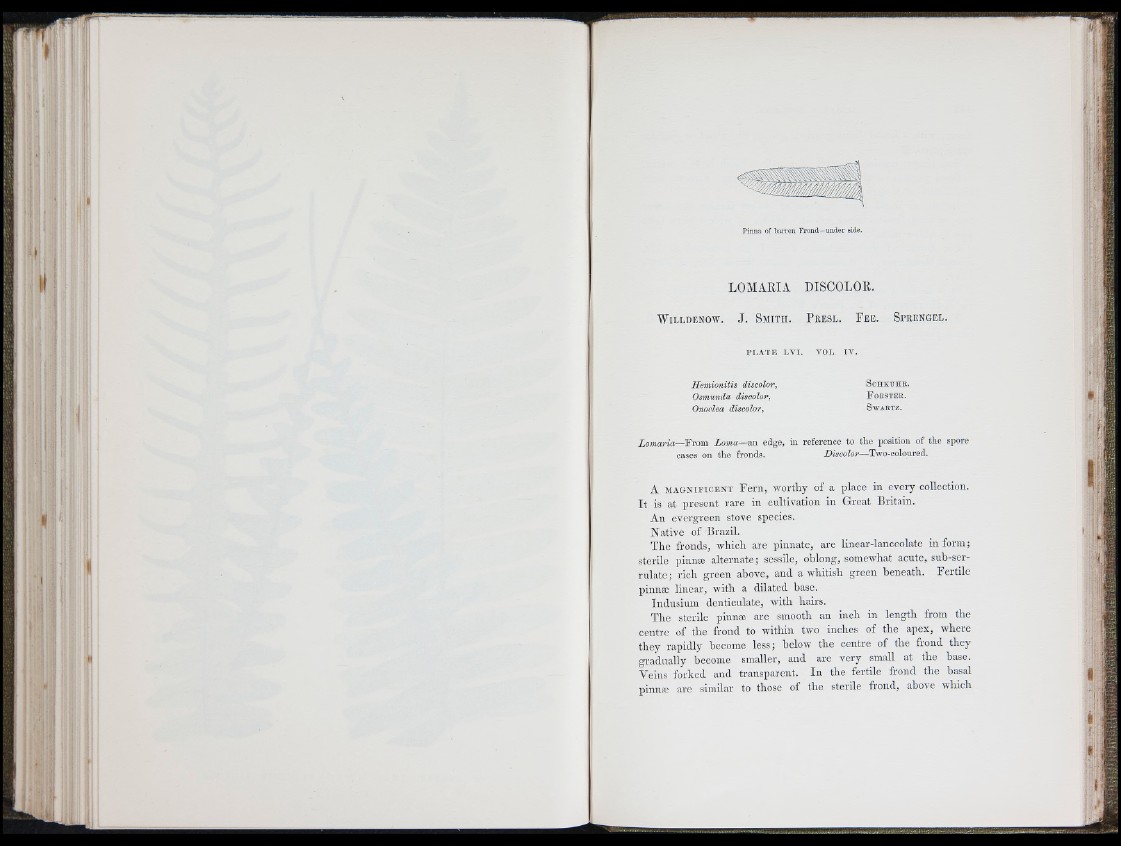
Pinna of barren F rond—under side.
LOMARIA DISCOLOR.
W i l l d e n o w . J. S m i t h . P r e s l . F e e . S p r e n g e l .
P L A T E L V I . V O L . IV .
Hemionitis discolor,
Osmunda discolor,
Onoclea discolor.
S c h k u h k .
F o k s t b e .
S w a e t z .
L om a ria— P m m L oma— an edge, iu referenoe to the position o f th e spore
cases on th e fronds. Discoloi— Two-coloured.
A M A G N IF IC E N T F c n i, Worthy of a place in every collection.
I t is at p re sen t ra re in cultivation in G re a t Britain.
A n evergreen stove species.
N a tiv e of Brazil.
T h e fronds, which are p innate, are linear-lanceolate in form;
sterile pinnæ a lte rn a te ; sessile, ohlong, somewhat acute, sub-serru
la te ; rich g reen above, and a whitish g reen beneath. F e rtile
pinnæ lin e a r, with a dilated base.
Ind u sium denticulate, with hairs.
T h e sterile pinnæ are smooth an in ch in len g th from the
centre of th e frond to within two inches of the apex, where
th ey rap id ly become less; below the centre o f the frond they
grad u a lly become smaller, and are v ery small at th e base.
Veins forked and transparent. I n th e fertile frond the basal
pinnæ are similar to those of the sterile frond, above which