w
I t . j - f ß f f ' i f ß i A ’i
n k ^ 0 ä P j / . : f V i
h . /
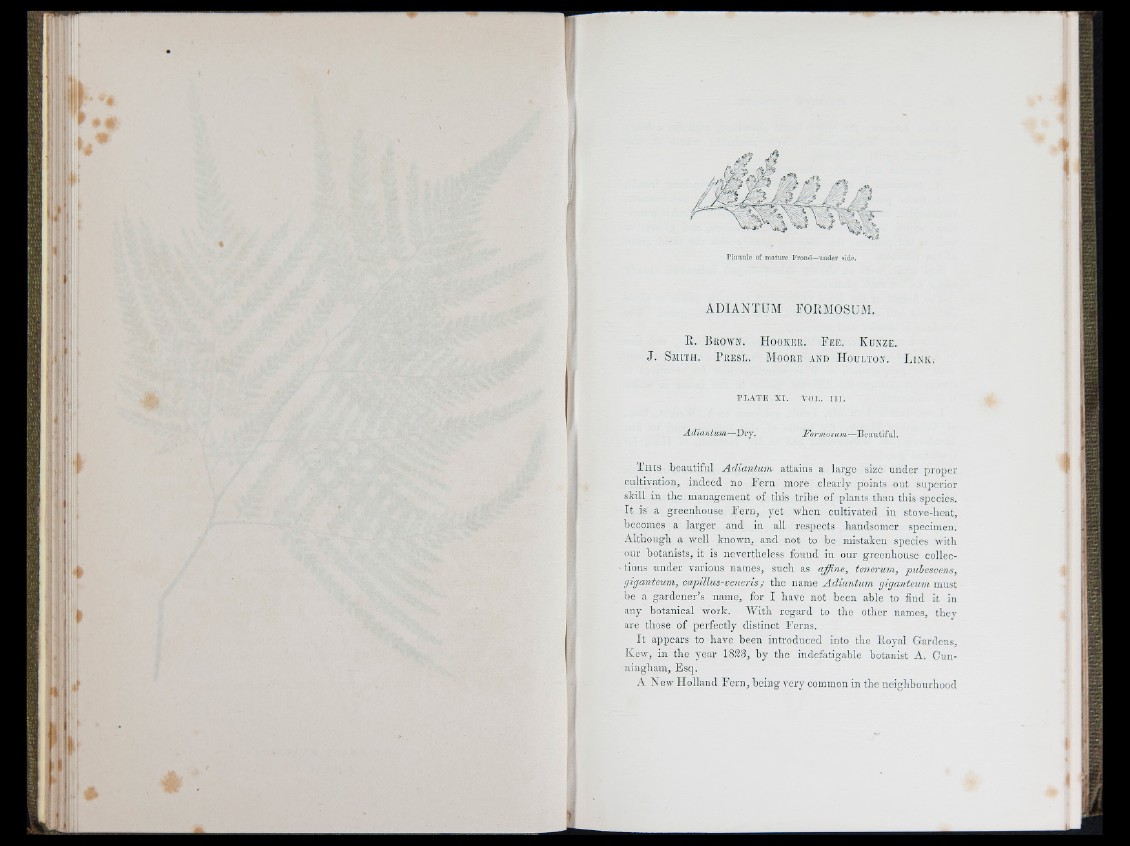
Pinnule of inatuvc Frond—under side.
ADIANTUM FORMOSUM.
R . B ro iv n . H o o k e r . F e e . K u n z e .
J . S.MIT11. P r e s l . M o o r e a n d H o u l t o n . L in k .
P I ,A T E X I . A O I.. I I I .
A d ian litm—Dry. P o rm o s u m — 13 p a iili f u l .
T u ts beautiful A d ia n tum attains a large size under pro p e r
cultivation, indeed no P e rn more clearly points out superior
skill in the management of this trib e of plants than this species.
I t is a greenhouse P e rn , yet Avhen cultivated in stove-hcat,
becomes a la rg e r and in all respects handsomer specimen.
Although a well known, and not to be mistaken species with
our botanists, it is nevertheless found in our greenhouse collec-
- tlons u n d e r various names, such as ajjfine, tenerum, pubescens,
ijiganteum, ca pillus-teneris; the name A d ia n tum giganteum must
be a g a rd en e r’s name, for I have not been able to find it in
any botanical work. IP ith reg a rd to the other names, they
are those of perfectly distinct Perns.
I t appears to have been introduc ed into the E o y a l Gardens,
Kcw', in the year 18S3, by the indefatigable botanist A. C u n ningham,
Esq.
A New H o llan d F e rn , being very common in the neighbourhood
♦