i «
t - i
i
OÍ the pimía'; usually two on each pinna, ¡uul when conñucut,
oí hall the width of the pinnæ, and reddish brown in colour.
V’eins branched.
Length ol frond twelve inches; colour rich green.
llhizoma erect.
Kachis and stijics ebeneous, rounded beneath, fluted above,
and much stouter than in A . formosum; the sori also bolder.
A . dentox has the pinnæ not dentate on the basal edge, the
upper edge and round the apex dentate, yet not deeply so as
in A . formosum; pinnæ broader and stouter than in A .
formosum.
For a plant my obligations are due to Mr. T. Downes, of
Ilfracombe.
It does not appear to be iu any of the Nurserymen’s Catalogues.
The illustration is from a plant in my own collection.
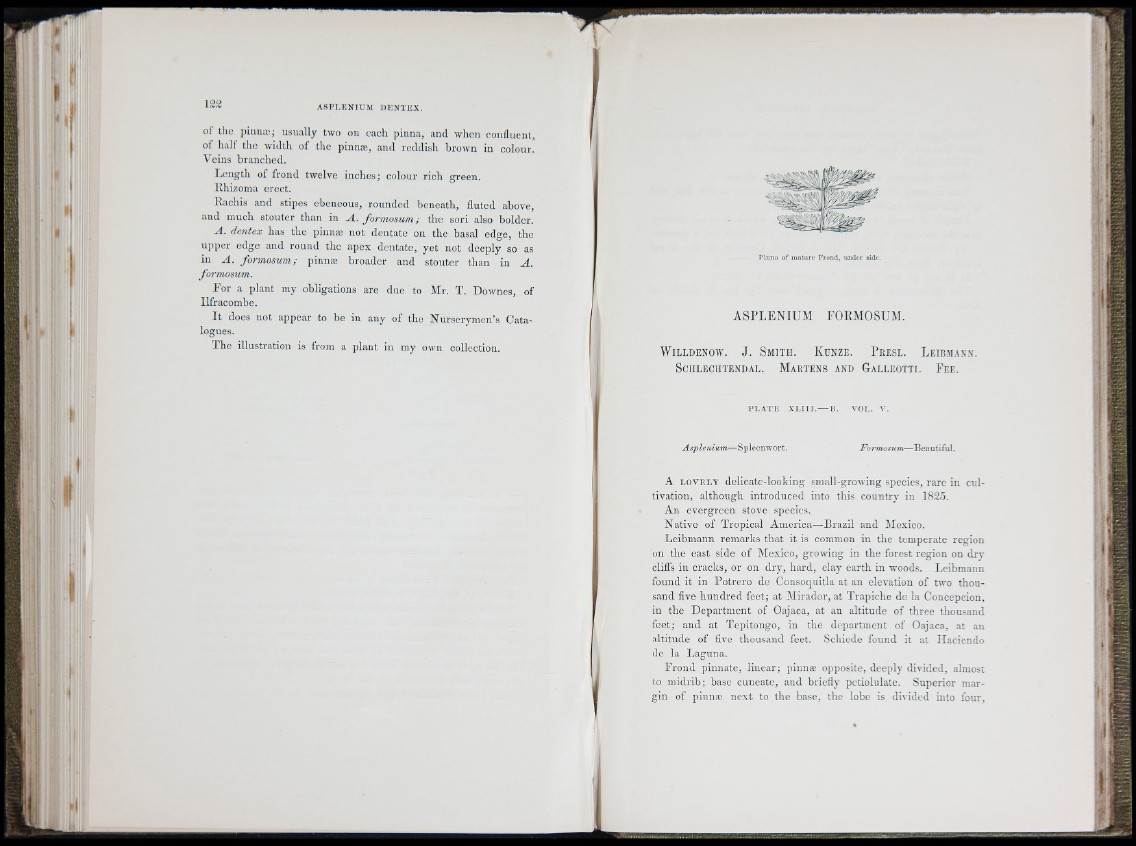
P i n n a o f m a tu r e F r o n d , u n d e r Bide.
ASPLENIUM FORMOSUM.
W il l d e n o w . J. S m i t h . K u n z e . P e e s l . L e ib m a n x .
S c i il e c i it e n d a l . M a r t e n s a n d G a l l e o t t i . F e e .
P L A T E X L I T I .— IL VOL . V.
Asp len ium—Spleenwort. Formosu m—Bea u tiñ il.
A LO V E L Y delicate-looking small-growing species, rare in cultivation,
although, introduced into this countrv in 1825.
An evergreen stove species.
Native of Tropical America—Brazil and Mexico.
Leibmann remarks that it is common in the temperate region
on the east side of Mexico, growing in the forest region on dry
cliffs in cracks, or on dry, hard, clay earth in woods. Leibmann
found it in Potrero de Consoquitla at an elevation of two thousand
five hundred feet; at Mirador, at Trapiche de la Concepcion,
in the Department of Oajaca, at an altitude of three thousand
feet; and at Tepitongo, in the department of Oajaca, at an
altitude of five thousand feet. Schiede found it at Haciendo
de la Laguna.
Frond pinnate, linear; pinnæ opposite, deeply divided, almost
to midrib; base cuneate, and briefly petiolulate. Superior margin
of pinnæ next to the base, the lobe is divided into four.
KB
ll