AST I,EX I u M !■’ I r,l X- FIE MIX A.
allow more than tlie enumeration of varieties; for a full description
the reader is referred to the “Nature-printed Ferns.”
Several of the varieties are so distinct in appearance as to
make it very desirable that they should be cultivated; indeed the
branched variety multifidum gives place to none in its delicacy
and beauty; the singular distorted and naked appearance of
the variety depauperatum, and the parslcy-look of the variety
crispum, make these three desirable additions to our Fernery;
whilst the feathery character of ocatum renders it an object to
be greatly admired; indeed no less interesting are the varieties
marmum, latifolium, rhæticum, incisum, and several others.
ilic variety multifidum is as large and graceful as the typical
form of Asplenium fiUx-foemina, and having all the points of
the division of the fronds multifid with tassel-like ends.
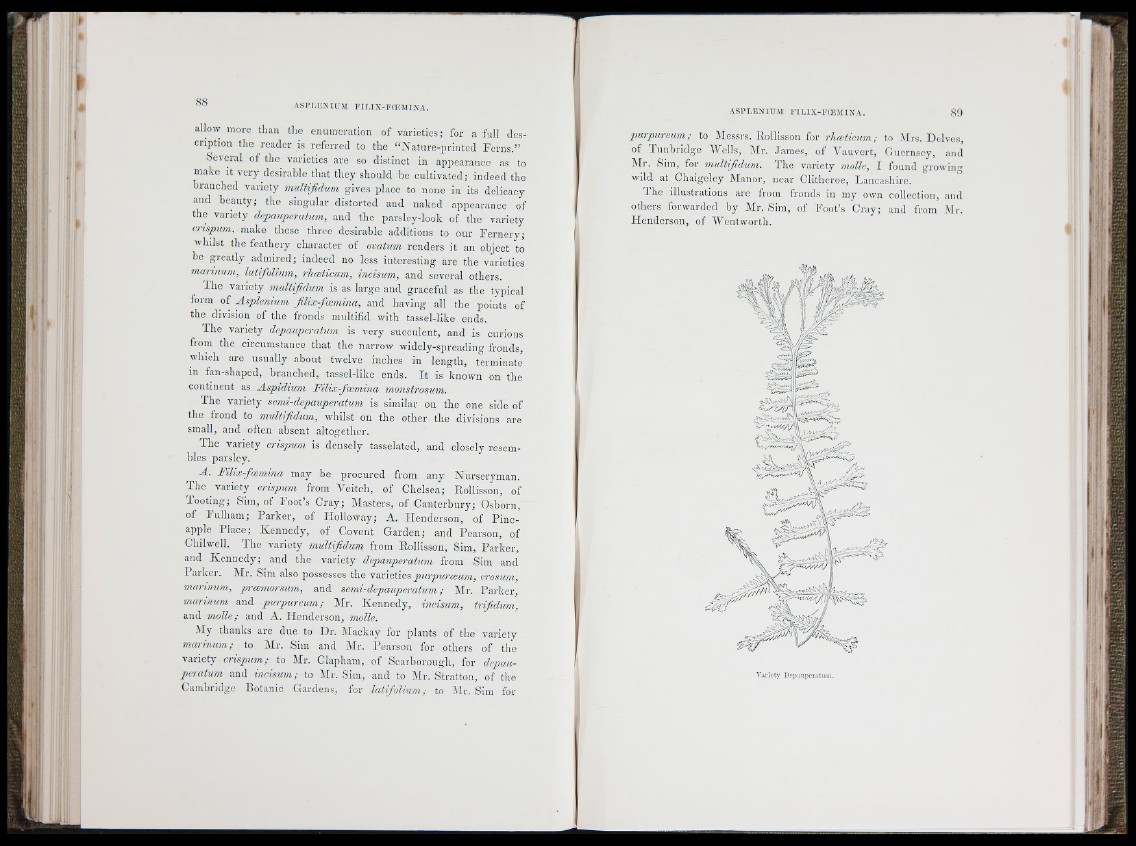
The variety depauperatum is very succulent, and is curious
from the circumstance that the narrow widely-spreading fronds,
which are usually about twelve inches in length, terminate’
in fan-shaped, branched, tassel-like ends. It is known on the
continent as Aspidmm Fdix-foemina monstrosum.
The variety semi-depaupcratum is similar on the one side of
the frond to multifidum, whilst on the other the divisions are
small, and often absent altogether.
The variety crispum is densely tasselated, and closely resembles
parsley.
A . F d ix foem in a may be procured from any ^Nurseryman.
D ie variety crisqmm from Veitch, of Chelsea; Rollisso'n, of
Tooting; Sim, of Foot’s Cray; Masters, of Canterbury; Osborn,
of lu lh am ; Parker, of Holloway; A. Henderson, of Pineapple
Place; Kennedy, of Covent Garden; and Pearson, of
Chilwell. The variety multifidum from Rollisson, Sim, Parker,
and Kennedy; and the variety depauperatum from Sim and
Parker. J\lr. Sim also possesses the varieties qnirpuræum, erosum,
marinum, qn-æmorsum, and semi-depauperatum ; Mr. Parker,
marinum and qmrpureum; Mr. Kennedy, incisum, trifidum,
and molle ; and A. Henderson, moUe.
J ly thanks are due to Dr. Mackay for plants of the variety
marinum; to Mr. Sira and Mr. Pearson for others of the
variety crispum; to Mr. Clapham, of Scarborough, for dipaupieratum
and incisum; to 3Ir. Sim, and to Mr. Stratton, of the
Cambridge Botanic Gardens, for latifolium; to "Mr. Sim for
purpureuni; to Messrs. Rollisson for rhccticum; to Mrs. Delves,
of Tunbridge Wells, Mr. James, of Vauvert, Guernsey, and
Mr. Sira, for multifidum. The variety molle, I found growing
wild at Chaigeley jNIanor, near Clitheroe, Lancashire.
Ih e illustrations arc from fronds in my own collection, and
others forwarded by Mr. Sim, of Foot’s Cray; and from Mr.
Henderson, of Wentworth.
j ': |I
i.li
Variety Dcpaupcvatiiin.
I 'li
I ,